PROTECT ALL
Shrink Wrapping Services
Trains, aircraft and an Edwardian steamship: what we've shrink wrapped
Light rail vehicles, helicopters, wind turbine components, automotive stamping dies, abatement enclosures, a shopping-mall escalator, and the roof of a 1907 steamship. Boats are the part of this trade people know about. Seventeen years in, they're a small share of the work.
What follows comes from our own job records rather than from anyone's press release. It's here because the question we get most often on a first call is some version of "have you done anything like mine before?"
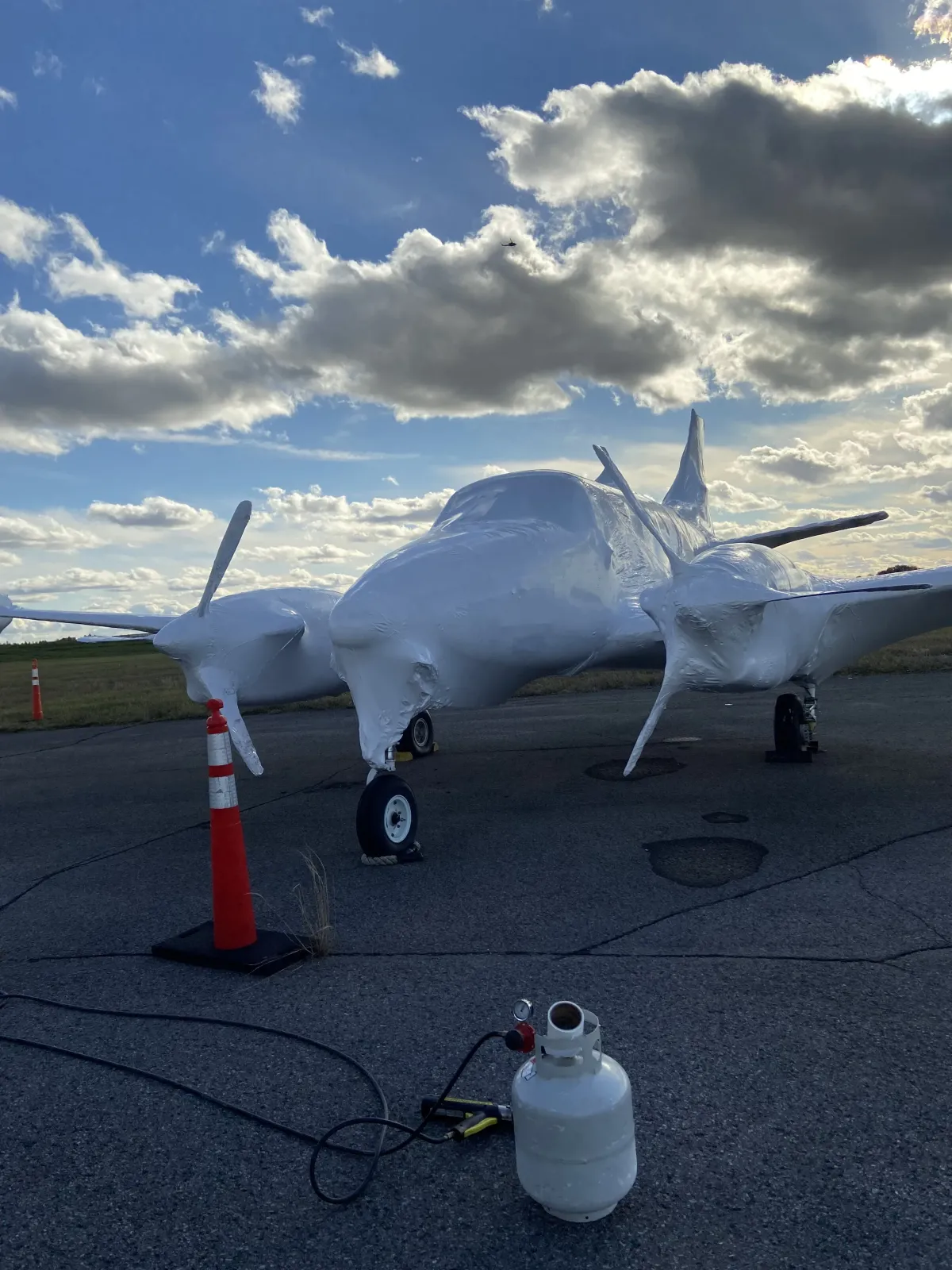
Aircraft and helicopters
We've wrapped light aircraft for storage while they were out of commission, and helicopters for long-distance moves by transport truck.
The reason this work exists is corrosion. The US Air Force's storage facility at Davis-Monthan — the "Boneyard", around 4,400 airframes — calls corrosion its public enemy number one, and its standard preservation is to wash the airframe thoroughly, drain and treat the systems, seal every opening, and spray a two-layer latex coating that blocks UV and reflects heat. They chose the Arizona desert for a reason. Ontario doesn't offer that option.
A wrapped airframe does the same three jobs by different means: seal the openings, block UV, keep moisture and wildlife out. Road moves add their own list — plexiglass gets protected before anything else touches it, fragile projections get padded, and access is left through a zippered door rather than by cutting the film open. Corrosion inhibitors go inside the wrap where metal needs them.
Rail vehicles
Light rail vehicles have been a steady part of the work — cars built for the TTC, OC Transpo, Vancouver's SkyTrain, Montreal's REM and the Kuala Lumpur network. Toronto's Flexity streetcars were built by Bombardier Transportation at Thunder Bay before Alstom acquired the business in January 2021; Ottawa's Citadis Spirit cars are Alstom's.
New rail vehicles are worth a great deal and travel badly. They typically move by rail flatcar for the long leg, then transfer to a specialized flatbed for the last stretch by road — where they meet stone chips, road salt, grime and weeks of weather. Wrapping is standard enough in the industry that Montreal's REM operator described its first cars arriving from India "wrapped in a white cocoon for extra protection" after twenty-three days at sea and eight hundred kilometres by truck.
The same logic applies to museum pieces. When a heritage trolley collection moved in 2025, the museum boarded the openings and then hired a contractor to shrink wrap both cars for the trip.
Industrial and infrastructure
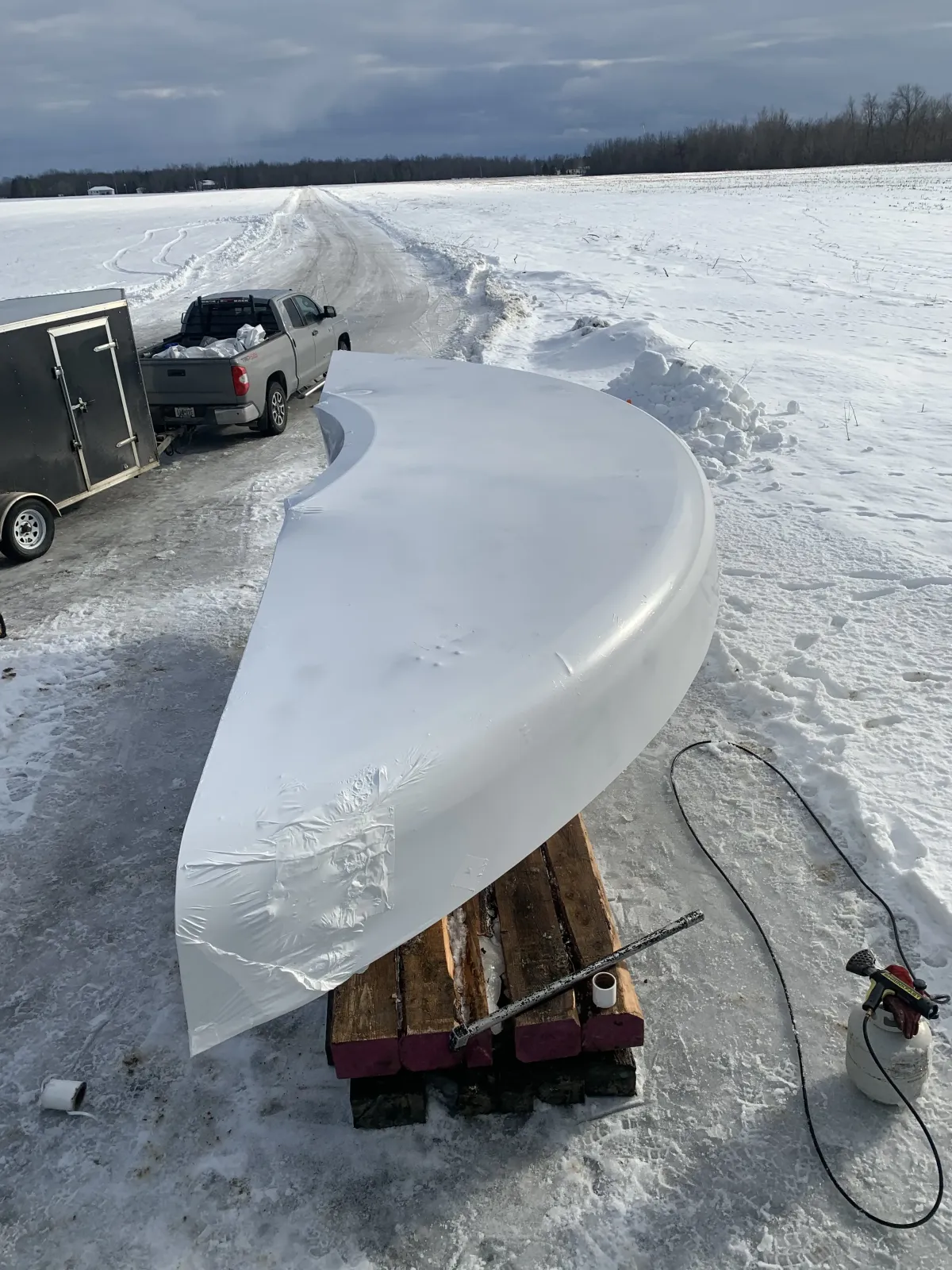
Wind turbine components at the Nation Rise Wind Farm near Finch, southeast of Ottawa — a 29-turbine Enercon project that reached commercial operation in June 2021. Components for a project that size arrive by vessel and truck over months and wait in a laydown yard before anything goes up. Blades are 75 metres and longer, they sit on purpose-built racks, and while they wait they take UV, temperature cycling and airborne grit.
Discontinued automotive stamping dies for Magna International. Tooling preservation is its own discipline: the industry standard is vapour corrosion inhibitor packaging inside a sealed, dry enclosure, and service-part tooling can need protecting for anywhere from five to twenty years after a model ends production. A die that rusts is not a die you can put back into a press.
And a long list of factory equipment wrapped for shipment across Canada, which is the bread and butter — machinery leaving a plant on a flatbed, sealed before it goes.
Containment and enclosures
Not everything gets wrapped to protect the object. Sometimes the film is there to contain what comes off it. Either way the heat tool comes out, which on most industrial sites means a hot work permit before we start.
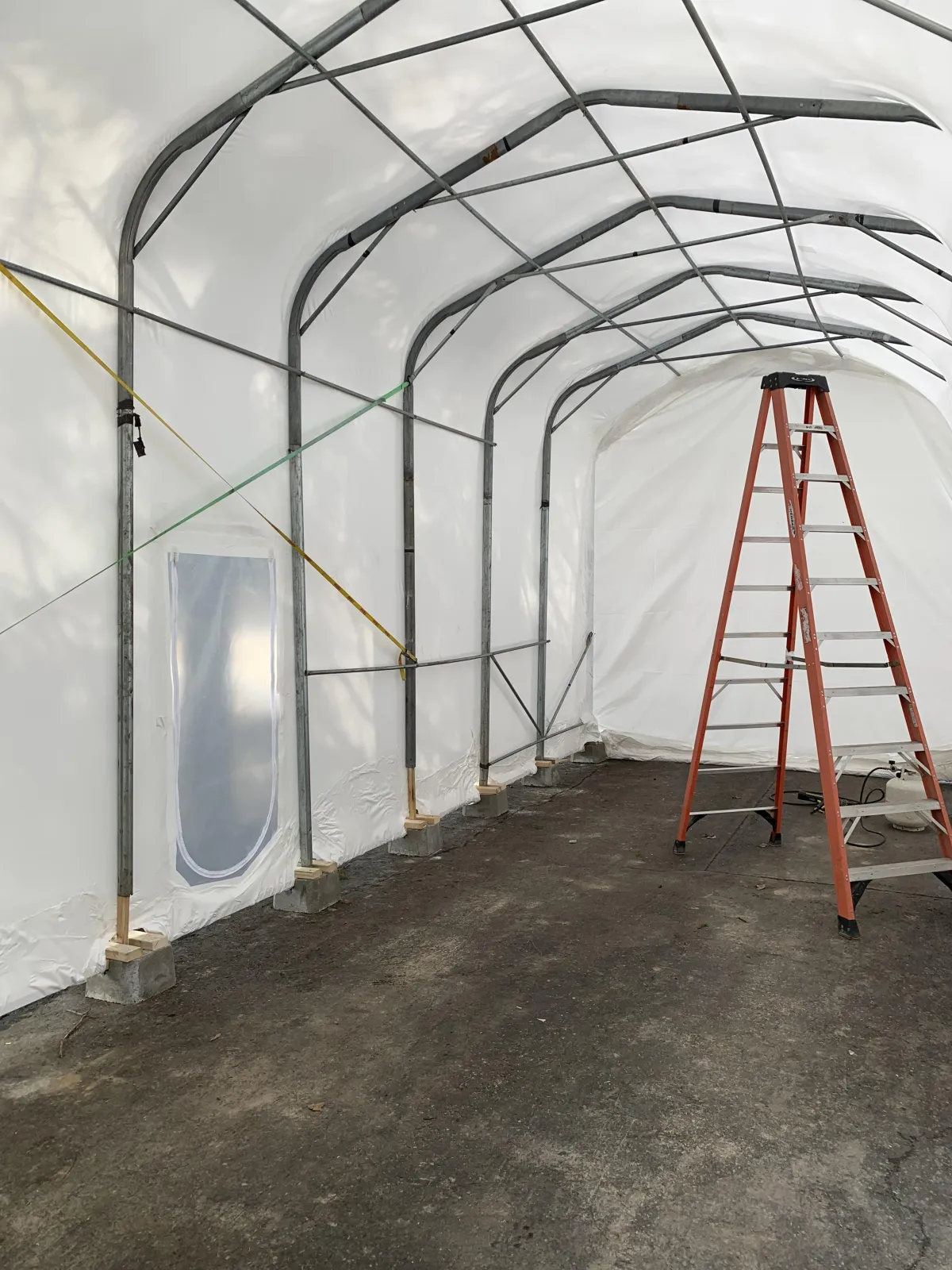
We've built scaffold enclosures for asbestos abatement around walls with asbestos-bearing paint, and huts for sandblasting. The method is regulated and specific: a frame sheeted in polyethylene, every seam, penetration and vent sealed, the whole enclosure held under negative pressure by HEPA-filtered units with make-up air drawn through a decontamination airlock, and roughly a full air change every ten minutes. The sheeting is the envelope that makes the rest of it possible.
Also in this category: open wall sections closed off on construction sites when the materials hadn't arrived, and an escalator in a shopping mall wrapped to keep construction dust and debris out of its mechanism. Different hazard, same principle — seal the boundary.
Got something unusual? Odd shapes and one-off problems are most of what we do. Send a photo and dimensions.
Heritage preservation
The jobs we're proudest of protect things that can't be replaced.
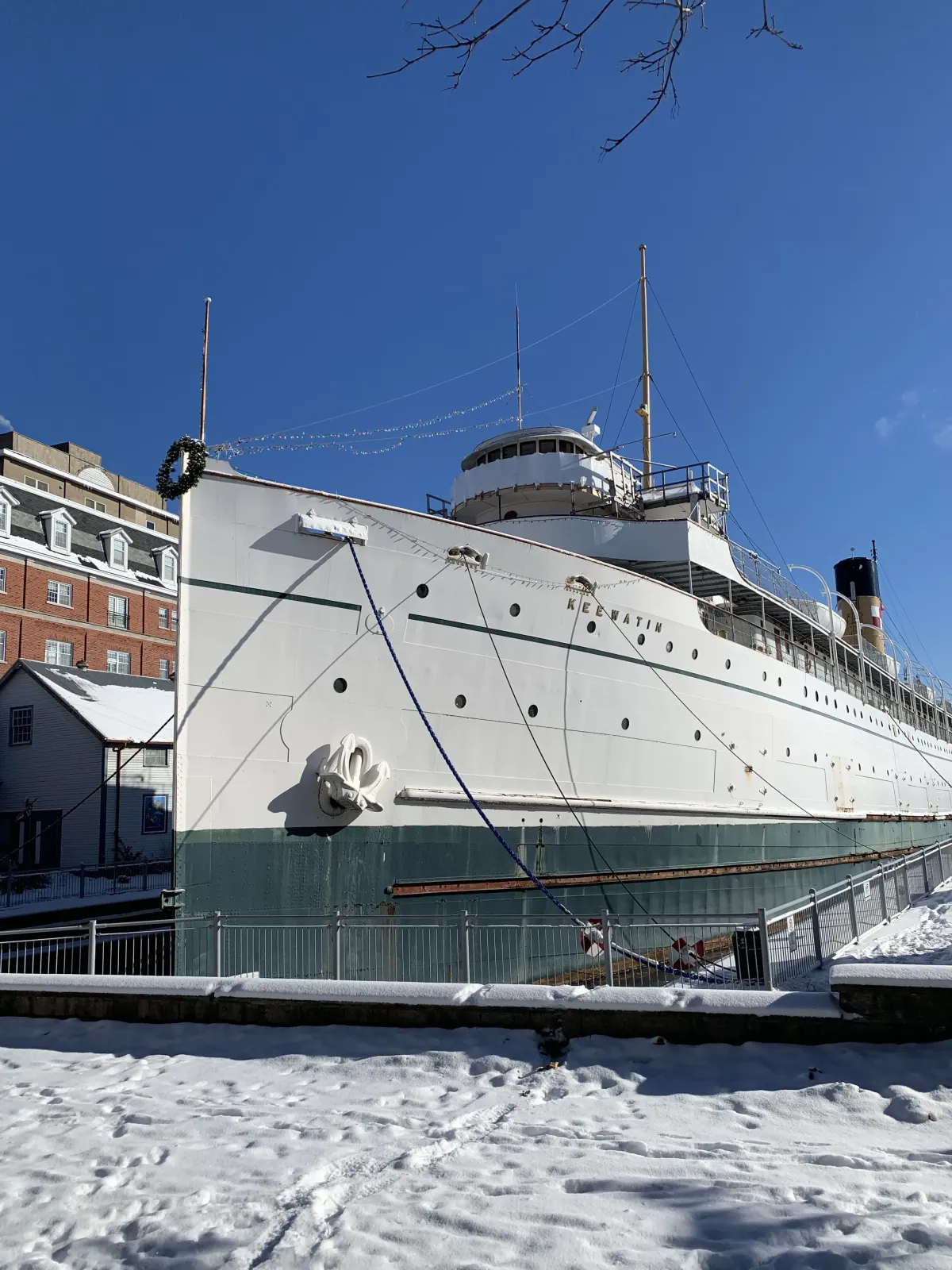
Roof sections and skylights on the SS Keewatin — a 1907 Great Lakes passenger steamship, five years older than Titanic and the last surviving Edwardian passenger liner of her kind. She arrived at the Great Lakes Museum in Kingston in October 2023 after decades at Port McNicoll, and opened to visitors the following May. She sits in our own city now — the kind of job you take at any price.
A full-scale Avro Arrow replica, wrapped while it was in storage near Toronto Pearson. Canada's most famous cancelled aircraft, and a replica that spent years being moved between homes.
The Thousand Islands Railway locomotive at Gananoque, wrapped for the winter months. And restaurant patio furniture, which belongs on a different list entirely but keeps a lot of Ontario restaurants from replacing their chairs every spring.
Heritage work comes with a rule the conservation field is firm about, and it's worth stating because it's where amateur wrapping goes wrong — the same reason a draped cover behaves so differently from a sealed wrap. The Canadian Conservation Institute's guidance on outdoor objects is wary of sealing a historic object inside anything impermeable — trapped moisture against a surface causes exactly the damage the wrap was meant to prevent. A heritage wrap has to breathe. Vent placement stops being a detail and becomes the job.
What each type of job is actually protecting against
| Asset | The real risk | What the wrap has to do |
|---|---|---|
| Aircraft in storage | Corrosion, UV, birds and rodents | Seal openings, block UV, stay ventilated |
| Rail vehicles in transit | Stone chips, salt, grime, weeks of exposure | Survive highway speed without lifting |
| Turbine components | Months of UV and grit in a laydown yard | Hold up over a full season outdoors |
| Stamping dies | Rust over years of dormancy | Seal dry, with corrosion inhibitor inside |
| Abatement enclosures | Fibre or dust escaping the work area | Hold negative pressure without leaking |
| Heritage objects | Weather — and trapped moisture | Shed water while still breathing |
Train your own crew to wrap
If permits are a recurring conversation at your site, it's usually cheaper to have your own people trained to handle the routine work.
- One day on site, 3–6 people, your own dock or yard
- All five attachment methods, propane tool handling, ventilation and on-site safety
- Starter kit supplied, plus equipment recommendations beforehand
- Free phone support for the first month of real jobs
Frequently asked questions
What is the largest thing you can shrink wrap?
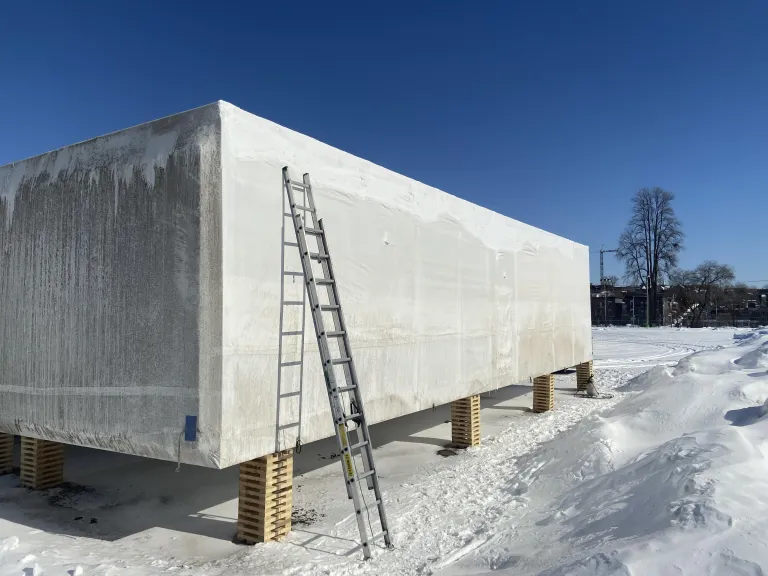
Size is rarely the limit — access and anchoring are. We've wrapped rail vehicles, aircraft and multi-storey scaffold enclosures. What decides feasibility is whether there's a way to build or attach a support structure, whether we can reach every surface safely, and what the site allows in terms of open flame and working at heights.
Can aircraft and helicopters be shrink wrapped?
Yes, for storage and for road transport. Windows and plexiglass are protected before anything else, fragile projections are padded, corrosion inhibitors go inside the wrap where metal needs them, and access is left through a zippered door. Venting matters more here than almost anywhere — a sealed airframe with trapped moisture is worse off than an uncovered one.
Do you wrap heritage and museum objects?
We do, and it's a different job from industrial wrapping. Conservation guidance is cautious about impermeable coverings on historic material because trapped moisture causes its own damage, so heritage wraps are built to shed water while still breathing. We'd expect to work alongside whoever is responsible for the object's conservation rather than around them.
Can equipment be wrapped for overseas shipping?
Yes. Sealed film handles salt air, deck exposure and weeks in transit, and it carries no wood, so it doesn't bring ISPM 15 treatment and stamping obligations with it the way a lumber crate does. For high-value loads a wrap over a crate is common — the crate takes impact, the film takes weather. We cover that trade-off in full in shrink wrap vs. crating.
Do you build asbestos abatement or sandblasting enclosures?
We build the sheeted enclosure — the sealed envelope over a frame or scaffold that the abatement or blasting work happens inside. Negative-pressure equipment, air monitoring, and the abatement work itself sit with the licensed abatement contractor. We're the containment, not the remediation.
Do you travel outside the Kingston area?
Regularly. We work across Eastern Ontario and the Toronto corridor as standard — Kingston, Ottawa, Belleville, Brockville, Peterborough, Toronto, Hamilton, Mississauga and Brampton — and travel further when the job justifies it. Rail, aviation and heritage work has taken us well beyond the usual radius.
How do you stop condensation forming under a wrap?
Vents, placed deliberately rather than sprinkled around. A sealed wrap with no airflow will collect condensation on the inside surface and drop it back onto whatever it's covering. Where metal needs more than airflow, vapour corrosion inhibitor products go inside the wrap. This is the single most common failure in DIY wrapping.
Sources used in this article
- 309th Aerospace Maintenance and Regeneration Group (AMARG) — aircraft preservation practice
- Canadian Conservation Institute — "Caring for outdoor objects" and CCI Notes N15/8, N15/9
- REM (Réseau express métropolitain) — vehicle delivery accounts
- EDP Renewables Canada — Nation Rise Wind Farm project data
- The Great Lakes Museum, Kingston — SS Keewatin
- Cortec / industry guidance on VCI tooling preservation
- OSHA 1926.1101 and equivalent abatement enclosure standards
On-site wrapping across Ontario
Industrial machinery & equipment
On-site protection for machinery, tooling and high-value equipment.
See details →Freight & cargo protection
Flatbed loads and oversized freight wrapped before transit.
See details →Construction containment
Sealed enclosures for containment, weather protection and temporary work areas.
See details →Outdoor storage protection
Equipment and assets sealed for laydown yards and seasonal storage.
See details →Vehicles & marine
Boats, vehicles and seasonal assets wrapped for storage or transport.
See details →On-site shrink wrap training
One day, 3–6 people, your own dock. Starter kit included.
See details →Protect All Shrink Wrapping Services — mobile, on-site industrial shrink wrapping across Ontario, based in Kingston, 17+ years in the trade.
Something on your site that doesn't fit a category?
Most of the jobs on this page started with someone unsure whether wrapping was even possible. Send a photo and rough dimensions and we'll tell you straight.

© Copyright 2026. Kingston, Canada. All rights reserved.