PROTECT ALL
Shrink Wrapping Services
Shrink wrap vs. tarps and fitted covers: what actually separates them
One is a sealed membrane, the other is a fabric held down at its edges. That single difference drives everything else — where water gets in, what snow does, and how the cover behaves at highway speed. Cost runs the other way: tarps win on price, decisively.
We wrap equipment for a living, so take the enthusiasm with the appropriate grain of salt. What follows is the version with the numbers in it, including the places where a tarp is the better call.
Membrane or fabric — the real distinction
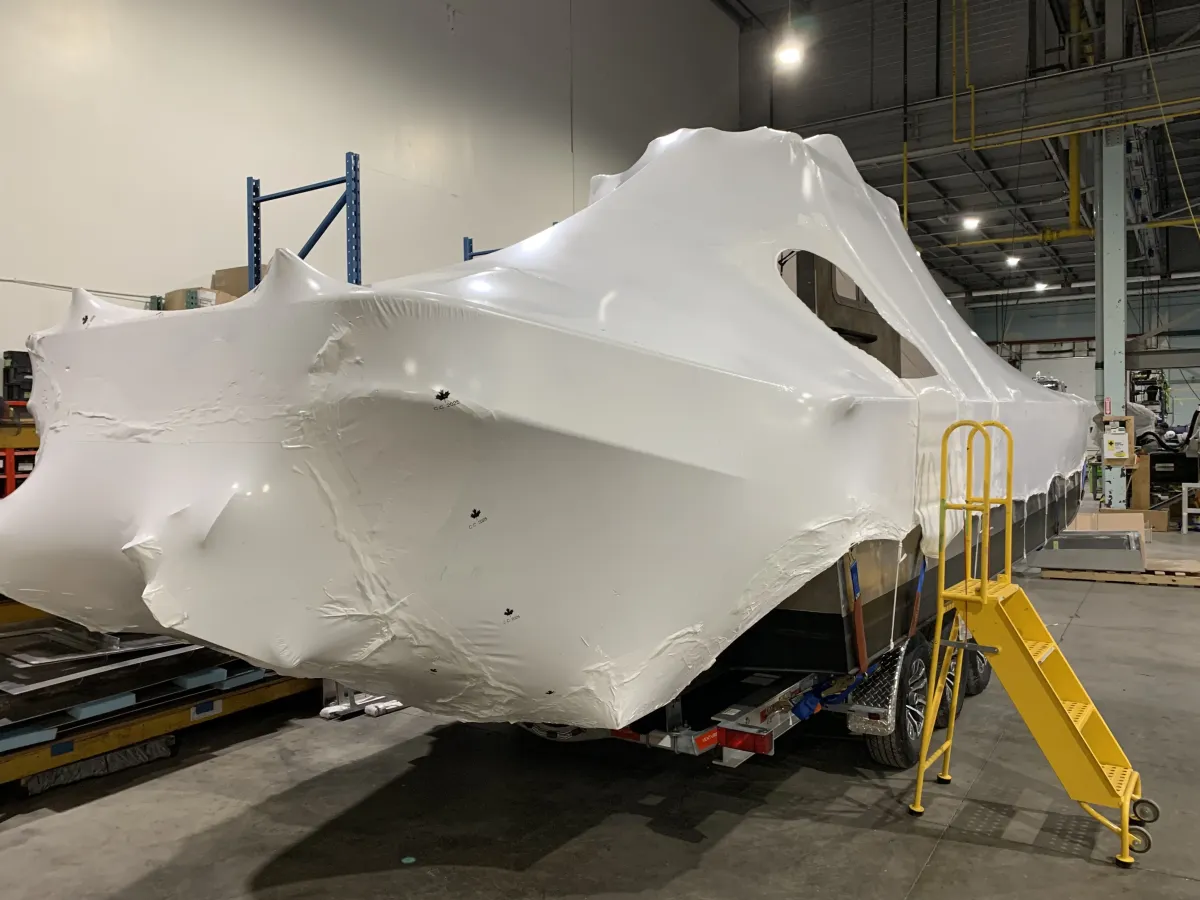
A tarp or fitted cover is woven fabric held down at the perimeter — grommets and rope, a drawstring, an elastic hem — and loose between those anchor points. A heat-shrink wrap is 6 to 12 mil polyethylene welded into one piece, then shrunk 25 to 30 percent so it pulls tight across the whole surface. Not tight at the edges. Tight everywhere. Everything below follows from that.
How the two behave, factor by factor
| Factor | Tarps & fitted covers | Heat-shrink film |
|---|---|---|
| Tension | Perimeter only — slack between anchor points | Whole surface, shrunk 25–30% onto the object |
| Water path | Stitched seams, grommet holes, worn coating | Welded seams; no stitch holes or grommets |
| Snow | Collects in slack pockets and adds weight | Sheds from a taut, pitched surface |
| Highway speed | Flutters; abrades what's underneath | Form-fitted, no flap |
| Outdoor UV life | Poly 1–3 years · vinyl-coated polyester 5–10 | About one year, UV-stabilized |
| Reuse | Reusable across many loads | Single use, then recycled or disposed |
| Upfront cost | Hundreds of dollars, then reused | A service call per job |
Read the UV row honestly, because it doesn't favour us: vinyl-coated polyester is documented at five to ten years outdoors, UV-stabilized film at roughly one. If you need something you'll pull on and off the same asset for a decade, buy the cover.
Water: where covers actually leak
The textile industry measures waterproofing as hydrostatic head — how tall a water column a fabric holds before letting water through, in millimetres, under ISO 811 and AATCC 127. Laminated poly tarps test around 1,500 to 5,000 mm when new. Vinyl-coated polyester runs 5,000 to 15,000, because the coating is continuous and the seams are welded rather than stitched.
Which gives the fair version, and it isn't the one on most shrink wrap websites: a new, intact vinyl tarp is genuinely waterproof by that standard. The fabric usually isn't the problem — everything it's attached to is. Stitched seams are perforations in a line, grommets are holes with metal pressed through them, and coating wears over a season. Cover manufacturers' own guides put seams, not fabric, at the root of most field failures. A one-piece film has none of them.
Film has its own weak point, for the record: its overlaps. A US patent on aircraft shrink-film packaging says the weakest portions are the seams, where wind and rain degrade the bond between overlapping sections. Fewer overlaps, better wrap.
Snow: the Ontario numbers
Here the difference stops being theoretical. Snow load is depth times density — fresh snow about 50 kg per cubic metre, settled about 200, wet packed about 400. So thirty centimetres of settled snow is about 60 kg on every square metre, and the same depth wet is about 120 kg. The Ontario Building Code's one-in-fifty-year ground snow load is 1.5 kPa for Toronto, 2.0 kPa for Kingston and 2.4 kPa for Ottawa — Kingston's is roughly 204 kg per square metre, between a third and half a metre of wet snow.
On a draped cover all of that lands in the slack, in the pocket between two tie-down points. The pocket deepens, collects more snow, deepens further. It ends one of two ways: the fabric tears or the grommets pull through, or it melts, pools and finds a seam.
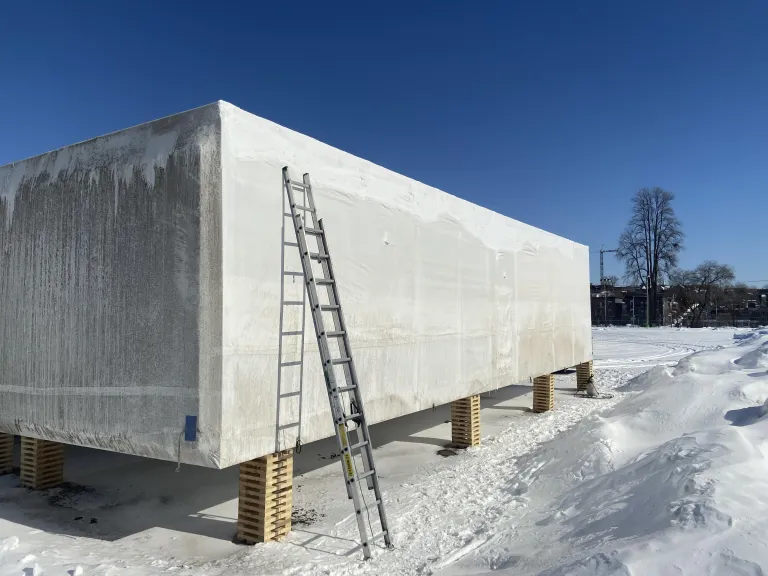
On a taut, pitched surface it slides off instead — the metal-roofing literature documents the mechanism, where a smooth sloped surface releases its snow pack once a film of meltwater forms underneath. The word doing the work is pitched: a wrap built flat on top holds snow like anything else, which is why the frame matters as much as the film. Most of our outdoor storage work is won or lost on that frame.
Two honest notes. Shrink wrap isn't immune — one contractor's own case study documents snow splitting the corners of a wrapped pipe stack. And on our jobs snow tends to let go once the sun is on the wrap, but what the literature documents is the taut slick surface, not solar warming; white film is made to reflect sunlight, not absorb it. Take the sun part as our observation, not physics.
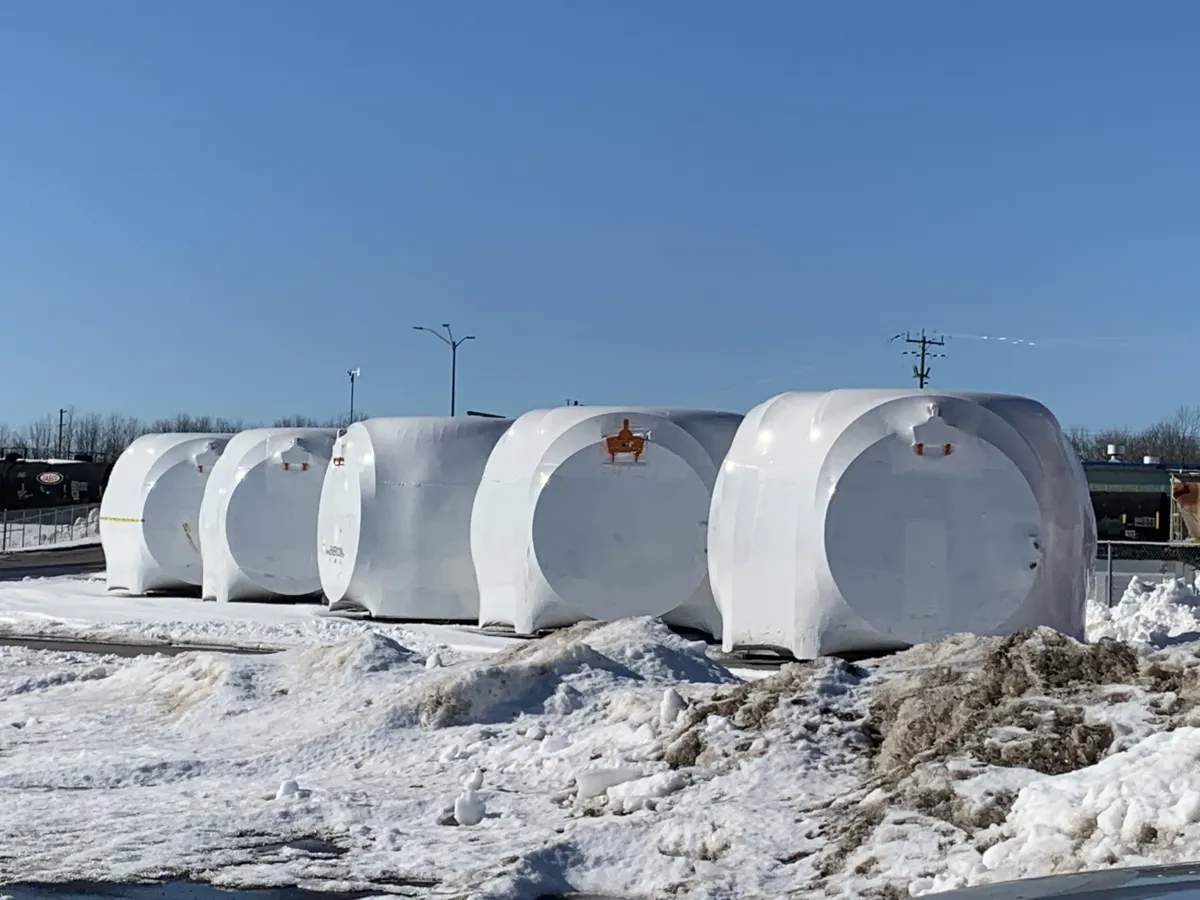
Something sitting outside for the winter, or heading out on a flatbed? Send dimensions and a photo — we'll tell you honestly if a cover would do the job.
Wind, transport and the law
A loose cover at highway speed doesn't just flap, it oscillates. That flutter fatigues fabric and stitching, delaminates coatings, tears out grommets and abrades whatever is underneath. Bungees make it worse: elastic permits the movement instead of preventing it. The clearest counter-data is a wind-tunnel test of a competing heat-shrink product — the film held at 160 km/h, the facility's maximum, without flapping or lifting, while conventional tarps failed in the same footage. Vendor-commissioned testing of someone else's product, but it's the best flutter comparison that exists.
Then there's the part that isn't about damage. On 6 April 2018 a truck ran a stop sign near Armley, Saskatchewan and struck the Humboldt Broncos team bus; sixteen people died and thirteen were injured. At sentencing the driver's own counsel told the court he had been distracted by a tarp flapping off the back of the truck and was looking at it in his mirror. The stated cause was failing to heed the stop sign — the flapping tarp was the documented distraction. We won't tell you a tarp caused that crash. But if you've wondered whether a loose cover is only a nuisance, that's your answer.
What Ontario law actually says
Two rules get conflated. O. Reg. 363/04, under s. 111 of the Highway Traffic Act, adopts National Safety Code Standard 10 — cargo securement, a tiedown standard, where a tiedown without a marked working load limit is deemed to have a limit of zero. R.R.O. 1990 Reg. 577, "covering of loads", is the one people assume covers weather. It doesn't — it targets aggregate escaping onto the road.
So neither tells you to protect equipment from rain. What the securement regime does require is that your load and its covering not become a hazard to others — which is where a cover flapping into a mirror stops being only your business. And for the record: shrink wrap is weather protection, not securement. Straps with marked working load limits do that, over the wrap, every time — the same rule applies to everything we wrap for freight and cargo.
Cost, honestly
Tarps are cheaper. A heavy 18 oz vinyl tarp runs a few hundred dollars and is reused for years; a set of six is around US$1,400. Against a service called out per job that isn't close, and anyone telling you otherwise is selling something. If you want the other side of that ledger in detail, we've broken down what industrial shrink wrapping actually costs in Ontario.
The sticker price leaves out the rest of the ledger. Carriers bill a tarping accessorial, commonly US$50 to $100 a load. Tarping takes 15 to 30 minutes for a single lumber tarp, 30 to 60 for multiple steel tarps, longer for an awkward machine, and wind can double it. Cheap poly wears out in one to three years. And tarps are heavy — 80 to 150 pounds, sometimes over 200 — handled on a deck five feet up, on loads reaching twelve.
That last part has a cost. An Ontario WSIB study of transportation claims screened 1,026 and found 352 falls from a truck, trailer or its cargo: 214 strains and sprains, 117 contusions, 101 fractures, with nearly a quarter injured more than once in the same event. That's falls from trucks generally, not tarping specifically — the tarping-specific fatality files come from Washington State. Neither is a clean comparison; both are worth knowing before deciding the cheap option is cheap.
And a third option people forget: a Conestoga or rolling-tarp trailer rolls its cover forward in five to ten minutes with nobody climbing anything, and carriers don't bill a separate tarp fee. It costs more to hire. On repeat lanes it often wins.
When a tarp is the right answer
We'd rather say this out loud than have you find out afterwards.
- The cover comes off weekly. Wrap is single use — buy a cover instead.
- The asset lives outside for years. Premium vinyl outlasts film several times over on UV alone.
- Standard freight on a repeat lane. Lumber, steel, palletized goods — drivers tarp those daily and they're good at it.
- Budget decides and exposure is short. A week in the yard in September is not a winter in Kingston.
We earn our keep on the other side of that list: awkward shapes no cover was cut for, a season outdoors in real snow, surfaces that can't take chafe, and anything that has to be sealed rather than draped.
Train your own crew to wrap
If permits are a recurring conversation at your site, it's usually cheaper to have your own people trained to handle the routine work.
- One day on site, 3–6 people, your own dock or yard
- All five attachment methods, propane tool handling, ventilation and on-site safety
- Starter kit supplied, plus equipment recommendations beforehand
- Free phone support for the first month of real jobs
Frequently asked questions
What are the disadvantages of shrink wrapping?
It's single use, so it costs more than reusing a tarp you own. UV-stabilized film gives about a year outdoors, well short of premium vinyl. It needs venting or condensation forms underneath, and a pitched frame or snow sits on it. Standard film is combustible, so flame-retardant grades are the right call near hot work.
Is shrink wrap waterproof?
A heat-shrunk wrap is a sealed one-piece membrane with welded seams and no stitch holes or grommets, so it has none of a fabric cover's leak paths. A new, intact vinyl tarp is also waterproof by the hydrostatic-head standard — the difference is that fabric covers leak at seams, grommets and worn coating over a season.
Do all loads need to be tarped?
No. Ontario's R.R.O. 1990 Reg. 577 requires covering for aggregate — sand, gravel, crushed stone, slag, salt and waste — to stop material escaping onto the road. It is not a weather rule and doesn't cover machinery or general freight. Covering other freight is a commercial decision, not a legal one.
How long will shrink wrap last?
UV-stabilized industrial film is built for roughly one year of exposed outdoor service — comfortably one Ontario winter. Thickness affects strength and puncture resistance rather than UV life, so a thicker film isn't automatically a longer-lasting one. Check the data sheet for the grade being used.
What can I use instead of shrink wrap?
Tarps and fitted covers for reusable, short-exposure protection; a Conestoga trailer for repeat freight lanes; crating where impact matters more than weather (we compare shrink wrap against crating separately); vapour-barrier bagging with desiccant for long-term corrosion control. It depends on exposure time, handling, and how often the cover comes off.
Does shrink wrap secure a load for transport?
No. Shrink film has no working load limit and is not a securing device. Under O. Reg. 363/04, which adopts National Safety Code Standard 10, securement is done with tiedowns carrying a marked working load limit — an unmarked tiedown is treated as zero. Straps go over the wrap; the film handles weather.
Is a tarp cheaper than shrink wrapping?
Upfront, clearly yes — a heavy vinyl tarp costs a few hundred dollars and is reused for years. Over a job's life the gap narrows: carrier tarping fees, 15 to 60 minutes of labour each way, short life on cheap poly, chafe damage, and the fall risk of handling 80-to-150-pound covers at deck height. For one winter outdoors or one high-value move, wrapping often costs less in total.
Sources used in this article
- Ontario Building Code / NBC 2020 SB-1 climatic data — ground snow loads
- O. Reg. 363/04 (Security of Loads) and National Safety Code Standard 10
- R.R.O. 1990, Reg. 577 — Covering of Loads
- ISO 811 / AATCC 127 — hydrostatic head test methods
- Jones & Switzer-McIntyre, "Falls from trucks: a descriptive study based on a workers compensation database" (Ontario WSIB claims)
- IIBEC Interface — "The Art and Science of Snow Mitigation on Metal Rooftops"
- Global News coverage of the Humboldt Broncos sentencing, January 2019
- Washington State FACE / L&I case files on tarping falls
On-site wrapping across Ontario
Industrial machinery & equipment
On-site protection for machinery, tooling and high-value equipment.
See details →Freight & cargo protection
Flatbed loads and oversized freight wrapped before transit.
See details →Construction containment
Sealed enclosures for containment, weather protection and temporary work areas.
See details →Outdoor storage protection
Equipment and assets sealed for laydown yards and seasonal storage.
See details →Vehicles & marine
Boats, vehicles and seasonal assets wrapped for storage or transport.
See details →On-site shrink wrap training
One day, 3–6 people, your own dock. Starter kit included.
See details →Protect All Shrink Wrapping Services — mobile, on-site industrial shrink wrapping across Ontario, based in Kingston, 17+ years in the trade.
Covering something that matters?
Tell us what it is, where it sits and how long it needs to survive. If a tarp would do the job we'll say so — and if it wouldn't, you'll get a quote with the WSIB and insurance paperwork attached.

© Copyright 2026. Kingston, Canada. All rights reserved.