PROTECT ALL
Shrink Wrapping Services
Shrink wrap vs. crating for shipping: which protects your equipment — and what each costs you in freight
Crating protects your equipment from impact. Shrink wrap protects it from weather. That's the honest version of this debate — and for a dense machine, the freight bill barely notices which one you pick. The real differences are speed, packaging cost, and what happens when a load is light for its size.
We wrap equipment for shipping across Ontario, so we have a side here — but most comparisons you'll find are written by crating companies, and they have one too. This is the version with the freight math actually shown.
What each method actually does
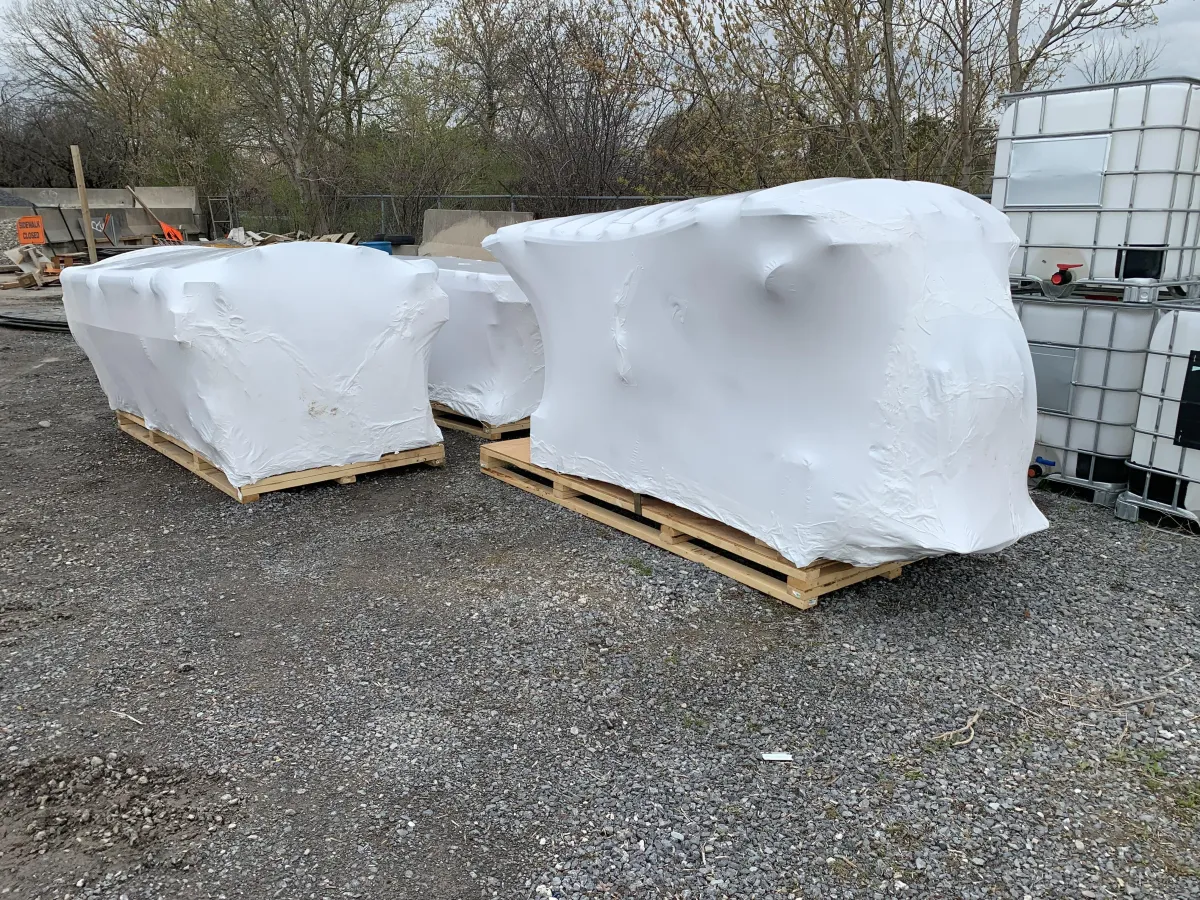
A wood crate is structural packaging. It takes forklift tines, shrugs off impacts, and carries stacked weight. A shrink-wrapped load on a skid is environmental packaging: 7–12 mil film heat-shrunk into a sealed skin that keeps out rain, road spray, dust and UV. Crating companies put it as "crate for impact, wrap for weather" — and they're right. The argument isn't about which is better; it's about which problem your load actually has.
Crate vs. wrap, factor by factor
| Factor | Wood crate | Shrink wrap on a skid |
|---|---|---|
| Impact & handling | Structural — built for forklifts, drops and stacking | None. Film is a skin, not armour |
| Weather & moisture | Only if lined and sealed | Sealed, shrink-fitted skin; vents control condensation |
| Added weight | Roughly 100–300 lb of lumber for a mid-size machine | A few pounds of film |
| Added size | 2–4 inches per side, plus the lumber | Follows the shape of the load |
| Turnaround | Designed and built — days | Wrapped on site — hours |
| Packaging cost | Custom carpentry; published US benchmarks run $1,000–5,000+ | A fraction of a custom crate |
| Export wood rules | Solid lumber means ISPM 15 treatment and stamping | No wood, nothing to stamp |
The freight math, Kingston to the GTA
Here's the mechanic that decides the money question. Canadian LTL carriers bill the greater of actual or dimensional weight, with a floor of 10 pounds per cubic foot — that's Day & Ross's Rule 25 (effective March 2026), Manitoulin's Tariff 100 and Purolator Freight's rate guide (June 2026), all saying the same thing. Volume ÷ 1728 × 10: if that number beats the scale weight, you pay for the air.
Run a 1,500 lb machine, roughly 48 by 40 inches, down the 401. Film-wrapped on a steel skid it ships at about 1,650 lb over 53 cubic feet — 31 lb per cubic foot, far above the floor, billed on actual weight. Crated, the same machine is about 1,700 lb over 72 cubic feet — 24 lb per cubic foot, still above the floor, still billed on actual. The difference is the crate's tare: about 50 extra pounds on the bill, a dozen dollars before the fuel surcharge. For a dense machine, the freight line barely moves.
Now flip it. Put a 500 lb machine in that same crate and the package is about 700 lb spread over 72 cubic feet — 9.7 per cubic foot, under the floor. The carrier now bills 719 lb of dimensional weight for a 500 lb machine, and the crate's bulk is driving the invoice. Light-and-bulky is where the wrap wins the freight argument outright. One more trap: loads taking 10 linear feet of trailer or more get billed at 1,000 lb per foot — a crate that nudges a 9-foot load past that line is an expensive piece of lumber.
Flatbed is simpler: it's priced by distance and deck space, not density. Packaging changes a flatbed rate only when it pushes the load over-width or over-height into permit territory. If your machine ships flatbed, choose packaging for protection, not freight.
One thing to un-learn: US freight classes (Class 50–500, the NMFC system) don't apply inside Canada. Canadian carriers use them on cross-border lanes only; a Kingston-to-Toronto move runs on the flat 10-per-cubic-foot rule. If a rate calculator asks you for a "freight class" on a domestic move, it's reading the wrong country's rulebook.
Shipping equipment and not sure which way to go? Send us the dimensions and the date — we'll tell you honestly if it needs a crate.
When crating wins
Honestly: often. Crate when the load is fragile or high-value with no tolerance for shock — machined surfaces, glass, calibrated instruments, exposed controls. Crate when freight will be double-stacked, and crate when it's riding LTL through multiple terminals: every extra touch is a chance to hit something, and industry surveys put LTL damage at roughly 1 in 80 shipments with an average claim near US$1,800. A box that a forklift can spear from any side deserves wood around it.
uShip's packing guidance tells LTL shippers to wrap units to the pallet and adds that "fully crating is encouraged" — for terminal freight with handling risk, that's fair advice, and we give it ourselves when the load calls for it.
When shrink wrap wins
Three situations, and they come up constantly.
The truck is booked for Thursday
A custom crate gets measured, designed and built — that's days, sometimes longer than the freight itself. A wrap happens on your dock in hours, the same day you call if the schedule allows. When the shipment date is fixed and the packaging isn't, the wrap is usually the only option that makes the truck.
The load doesn't fit a box
Oversized, irregular, or already on its own frame — film follows the shape instead of forcing a rectangle around it. That also keeps the footprint honest: no clearance inches, no lumber, no paying to ship geometry you added yourself.
The wood itself is the problem
For export, ISPM 15 obligations — heat treatment, stamping, paperwork — attach to solid wood packaging. A load wrapped in film on a steel skid carries no wood, so there's nothing to treat or stamp. Worth knowing the full rule: plywood-only crates are exempt too; it's solid lumber members that bring the regime in. CFIA's wood packaging guidance is the source to hand your customs broker.
And the two aren't enemies: on high-value exports we're often the second layer — a wrap over the crate, weather seal over the armour. Crating companies recommend the same pairing. For what the wrapping side of that equation runs, see our breakdown of what industrial shrink wrapping costs in Ontario.
What neither one does: secure the load
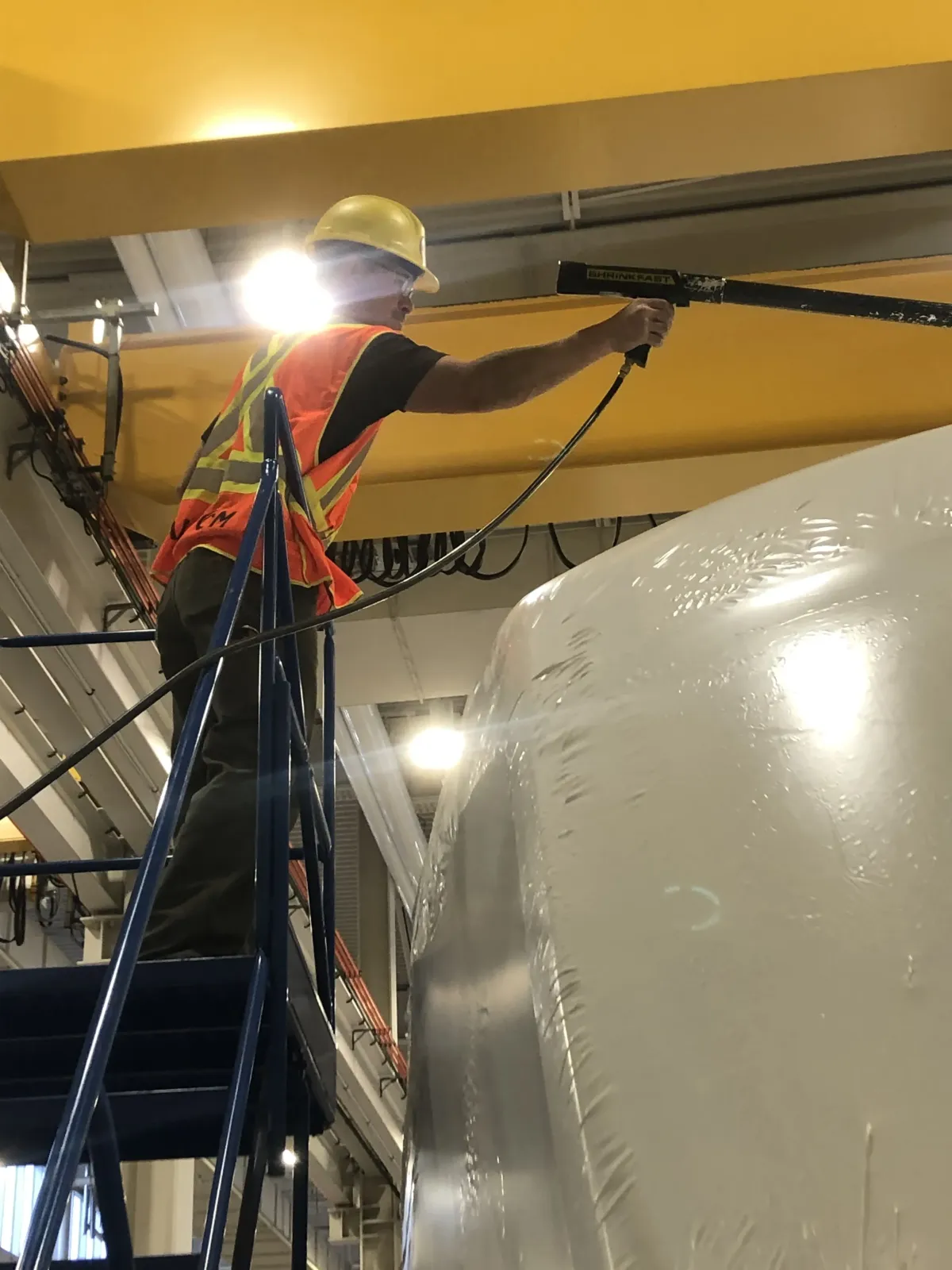
Neither a crate nor a wrap holds freight to the truck. Under Ontario's cargo securement rules, that job belongs to tie-downs with a marked Working Load Limit — and shrink film has none. On a flatbed, straps and chains go over the wrap; when we handle freight and cargo protection, we place edge protectors so the bindings don't cut the film. What the wrap contributes is protection and consolidation — the load arrives clean, dry and intact, which is what keeps claims off your desk.
- Ask what you're protecting against
Impact and stacking → crate. Weather, dust and road spray → wrap. Both at once → wrap over crate.
- Check the density
Heavy and compact ships the same either way. Light and bulky pays for the crate's air — dimensional weight starts at 10 lb per cubic foot.
- Look at the calendar
Days of lead time buys carpentry. Hours buys film. If the truck's already booked, that answer is made for you.
Train your own crew to wrap
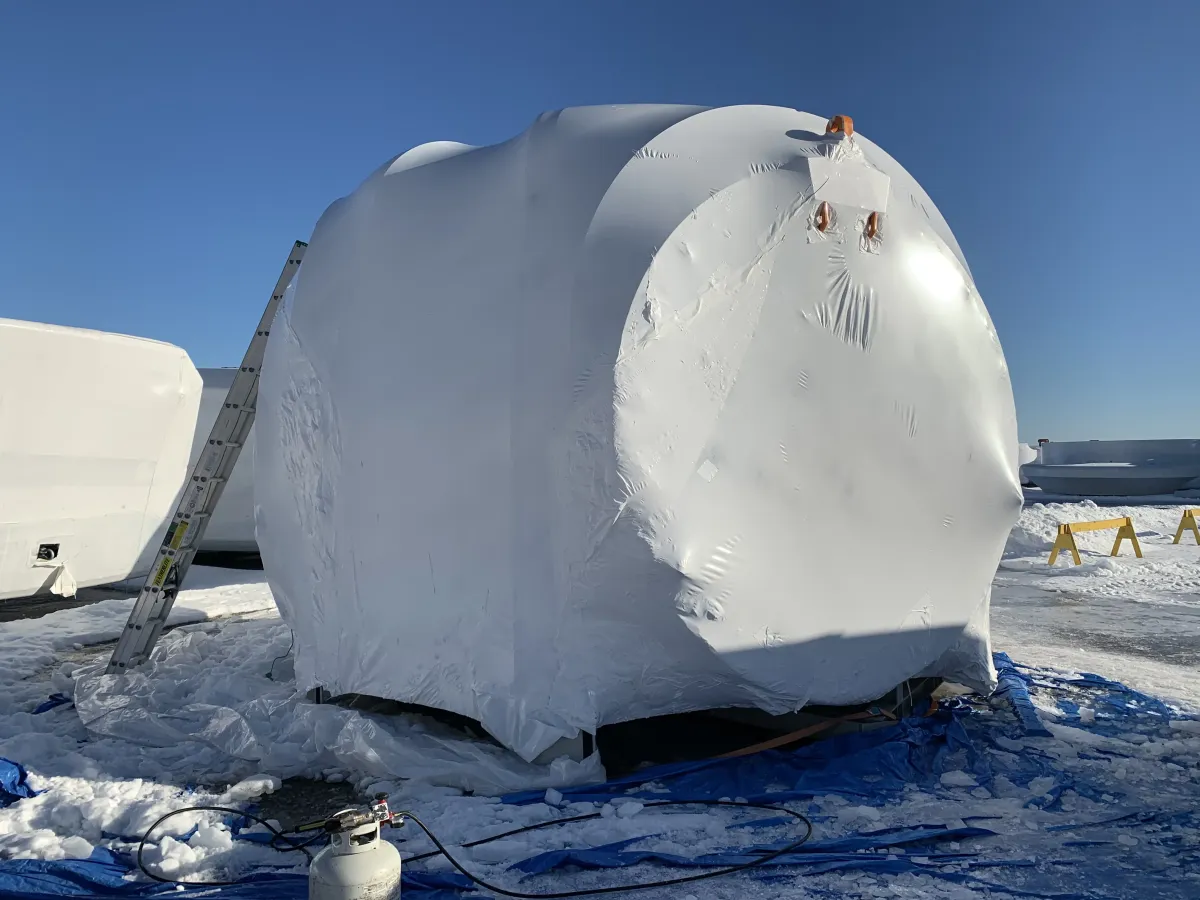
If permits are a recurring conversation at your site, it's usually cheaper to have your own people trained to handle the routine work.
- One day on site, 3–6 people, your own dock or yard
- All five attachment methods, propane tool handling, ventilation and on-site safety
- Starter kit supplied, plus equipment recommendations beforehand
- Free phone support for the first month of real jobs
Frequently asked questions
What are the disadvantages of shrink wrapping?
Film gives no impact protection — a forklift tine goes straight through. It needs proper venting or condensation builds under the skin, it's single-use where a crate can be reused, and standard film is combustible, so flame-retardant grades are the right call where people work near it. For fragile, stackable or terminal-bound freight, a crate does things film can't.
Can I ship something wrapped in shrink wrap only?
Yes, if the load can take normal handling on its own — machinery on a solid base, skidded equipment, loads travelling flatbed with straps over the film. For LTL freight passing through multiple terminals, or anything fragile, add structure: a crate, or at minimum corner protection and a rigid base.
Is pallet wrap the same as shrink wrap?
No. Pallet (stretch) wrap is thin film — often under 1 mil — stretched around a load to hold boxes together. Industrial shrink wrap is 7–12 mil film heat-shrunk into a tight, weatherproof skin. Stretch wrap holds a pallet tidy; shrink wrap seals equipment against months of weather.
What can I use instead of shrink wrap?
Tarps (reusable but loose-fitting and prone to flapping), crates (structural but heavy and slow to build), vapour-barrier bagging with desiccant for long-term corrosion control, or blanket wrap for padded indoor moves. Which one wins depends on exposure time, handling and budget — often the answer is a combination.
Does ISPM 15 apply to shrink-wrapped cargo?
ISPM 15 regulates solid wood packaging — pallets, crates, dunnage. Cargo wrapped in film on a steel or plastic skid has no wood to treat or stamp, so the regime doesn't attach. Note the nuance: crates made entirely of processed wood like plywood are also exempt; it's solid lumber that triggers the requirement.
Does shrink wrap secure a load for transport?
No. Film has no Working Load Limit and is not a securing device under Ontario's cargo securement rules. Tie-downs with marked WLL do that job, placed over the wrap with edge protection. The wrap's role is weather and contamination protection, not restraint.
How fast can a load be wrapped before shipping?
Hours, not days. A typical machine or skidded load is wrapped on site in a single visit, and same-day service is often possible when the schedule demands it. The practical limit is usually site access and paperwork, not the wrap itself.
Sources used in this article
- Day & Ross Domestic Master Tariff DR1997, Rule 25 (density) and Rule 26 (cube), effective March 2026
- Purolator Freight LTL Rate Guide, effective June 30, 2026
- Manitoulin Transport Tariff 100 (Canada)
- CFIA — Wood packaging questions and answers (ISPM 15 scope)
- uShip — How to Package Your LTL Shipment
- Flock Freight 2025 Shipper Research Study (LTL damage rates, US)
- Crating Technology — industrial heat shrink wrapping services page
On-site wrapping across Ontario
Industrial machinery & equipment
On-site protection for machinery, tooling and high-value equipment.
See details →Freight & cargo protection
Flatbed loads and oversized freight wrapped before transit.
See details →Construction containment
Sealed enclosures for containment, weather protection and temporary work areas.
See details →Outdoor storage protection
Equipment and assets sealed for laydown yards and seasonal storage.
See details →Vehicles & marine
Boats, vehicles and seasonal assets wrapped for storage or transport.
See details →On-site shrink wrap training
One day, 3–6 people, your own dock. Starter kit included.
See details →Protect All Shrink Wrapping Services — mobile, on-site industrial shrink wrapping across Ontario, based in Kingston, 17+ years in the trade.
Shipping equipment soon?
Tell us what's moving and when the truck comes. We'll say honestly whether it needs a crate, a wrap, or both — and send our WSIB and insurance paperwork with the quote.

© Copyright 2026. Kingston, Canada. All rights reserved.