PROTECT ALL
Shrink Wrapping Services
What does industrial shrink wrapping cost in Ontario? A 2026 guide to the real numbers
For boats and RVs, published Canadian mobile wrapping rates run roughly $17 to $31 a foot. For industrial equipment, freight and containment, almost nobody in Canada publishes a price at all — quotes are built from height, access, framing and film. Here's what the published numbers actually say, and what builds an industrial quote.
Fair warning about what you'll find if you search this yourself: the results are film rolls and wrapping machines, not services. The top result right now is a $15 roll from a computer-parts wholesaler — more on why that number can't wrap a machine below.
What's actually published in Canada
Two markets, two habits. Recreational wrapping — boats, RVs, PWCs — is sold per linear foot, and rate cards are public. Industrial wrapping is quote-only almost everywhere in the country. Here's every published Canadian number worth citing, checked August 2026.
Published Canadian shrink wrapping rates, 2024–2026
| Source | Published rate (CAD) | Notes |
|---|---|---|
| City of Barrie marina (Fees By-law, Schedule L) | $20–29/ft by boat length, wrap only | Municipal, drop-off. Add-ons: flybridge $150, radar arch $80 |
| Dyck's Mobile, Kelowna BC | $20–26/ft on land, $25–31/ft in water | Includes frame, four vents, desiccant, seasonal warranty |
| M.A.D Mobile, Niagara ON | $12–20/ft; runabout average $180–300 | Mobile; removal from $75. Industrial side is quote-only |
| Ontario marinas (Fish Bay, Fenelon Falls, Marine Plaza) | $17–28/ft | Drop-off service, framing usually included |
| Independent mobile operators, Ontario | $17–22/ft | Classifieds listings, 2024–2026 |
| Hex Scaffolding, Kelowna BC — containment | $1.55/sq ft | The only published Canadian industrial rate we found |
A correction worth pinning: the widely quoted "Barrie charges $32–41 a foot" figure bundles shrink wrap with winter storage. The city's own fee schedule prices the wrap alone at $20–29 a foot. Quoting the bundled number overstates the going municipal rate by 40–60 percent.
The industrial column is nearly empty on purpose — that's the market. Every Ontario industrial operator we checked, ourselves included, quotes per job. The rest of this page shows you what those quotes are made of, so a "call for pricing" doesn't have to mean flying blind.
The $15 roll that ranks #1
Search this topic and the first thing Google hands you is a wholesale roll of "industrial shrink wrap" — 19.68 inches wide, 80 gauge, $15–20. Here's the problem: 80 gauge is 0.8 mil. That's pallet stretch film, the stuff you spin around boxes to keep a skid tidy. Industrial shrink film is 7 to 12 mil — roughly ten times thicker — heat-shrunk into a rigid, UV-stabilized skin. You can no more wrap a machine for outdoor storage with pallet stretch than you can shingle a roof with cling film.
The confusion is baked into the units. Stretch film is sold in gauge (80 gauge ≈ 0.8 mil); shrink film in mil. Same word "wrap", different products, an order of magnitude apart in thickness — and the price difference between a $15 roll and an industrial job starts right there.
From the price of a roll to the price of a job
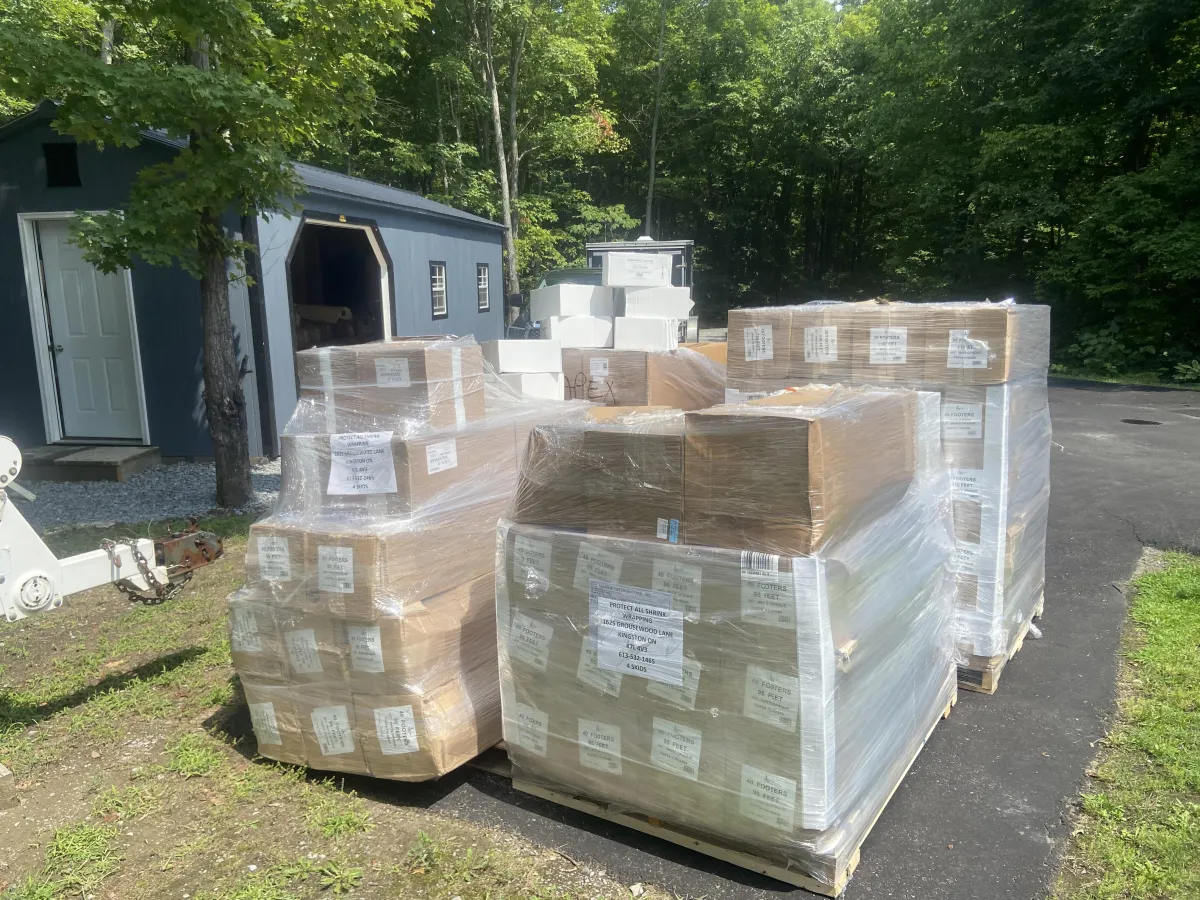
Even the right film doesn't get you to a job price, and here's the arithmetic nobody publishes. A marine-grade roll of 7 mil film, 17 by 110 feet, retails in Canada for roughly $300–600 — call it 1,870 square feet. A mid-size machine, say 8 by 6 by 7 feet, needs about 245 square feet of surface covered; add a third for overlap, welds and waste and you're near 320. That's a sixth of a roll: $50–100 of film.
So on a typical machine, the material is under a hundred dollars. Everything else in a quote is the part a retailer can't sell you: the support framing, the venting, heat work done safely near your equipment, the access problem, the drive, and a crew that's done it a thousand times. That's also why "how much is a roll" and "how much is the job" are different questions with different answers — and why the roll price ranking #1 on Google tells you almost nothing.
What builds an industrial quote
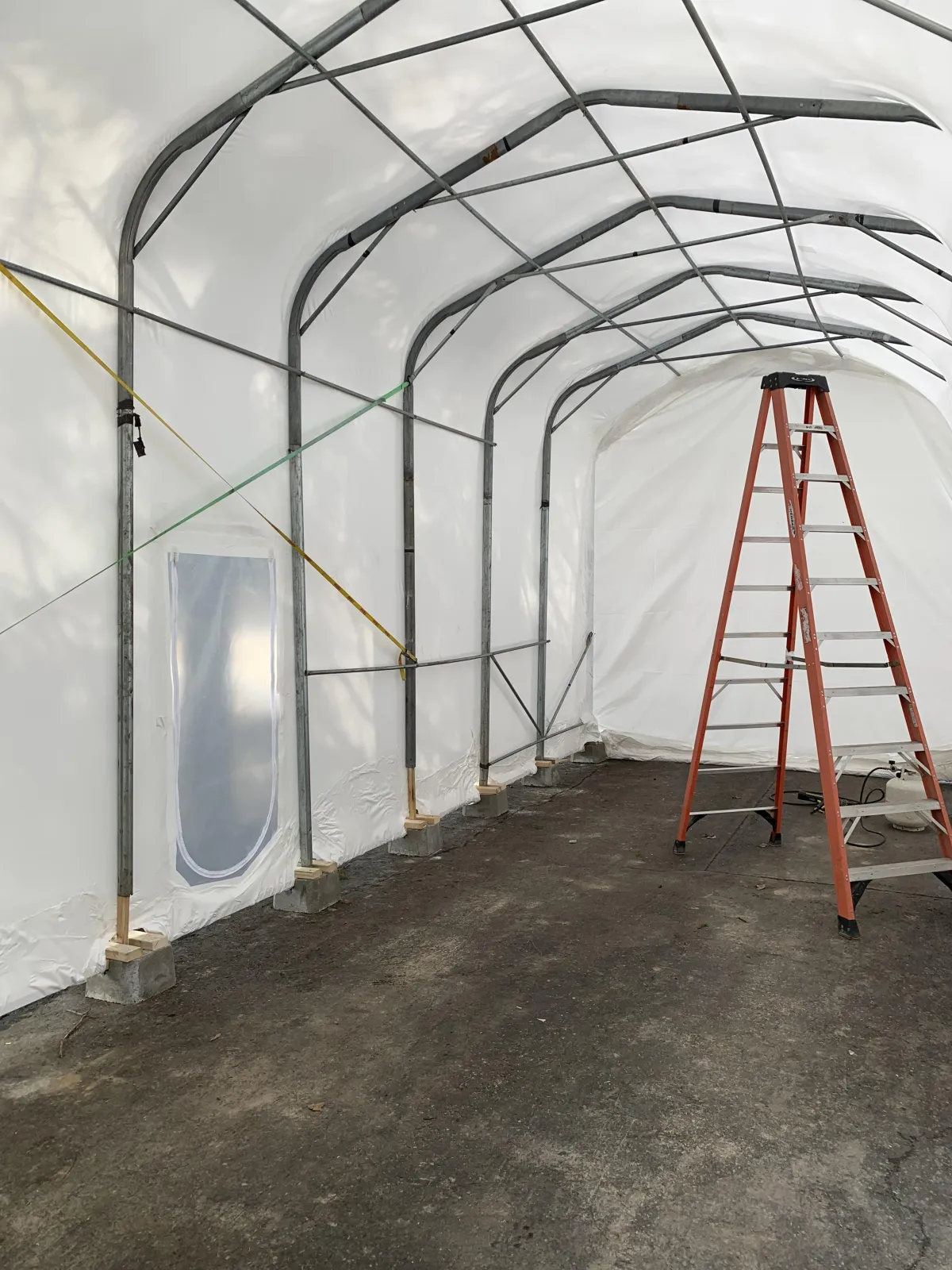
Six drivers, in roughly the order they move the number:
- Height and access. Ground-level skids wrap fast. Anything needing ladders, lifts or Working at Heights time costs more — the one published Canadian containment rate, $1.55 per square foot, is for scaffold wrap, and US scaffold benchmarks run US$1.50–6.00 depending on height and complexity.
- Framing. Film needs something to shrink against. A machine with its own hard points needs little; a long open load needs a built structure, and that's lumber and hours.
- Film specification. Flame-retardant film — the right call wherever people work under or near the wrap — costs more than standard. So does extra width and heavier mil.
- Wind exposure and tensioning. An open yard in November is a different job than a loading dock. Exposure decides tension work, reinforcement and sometimes the schedule.
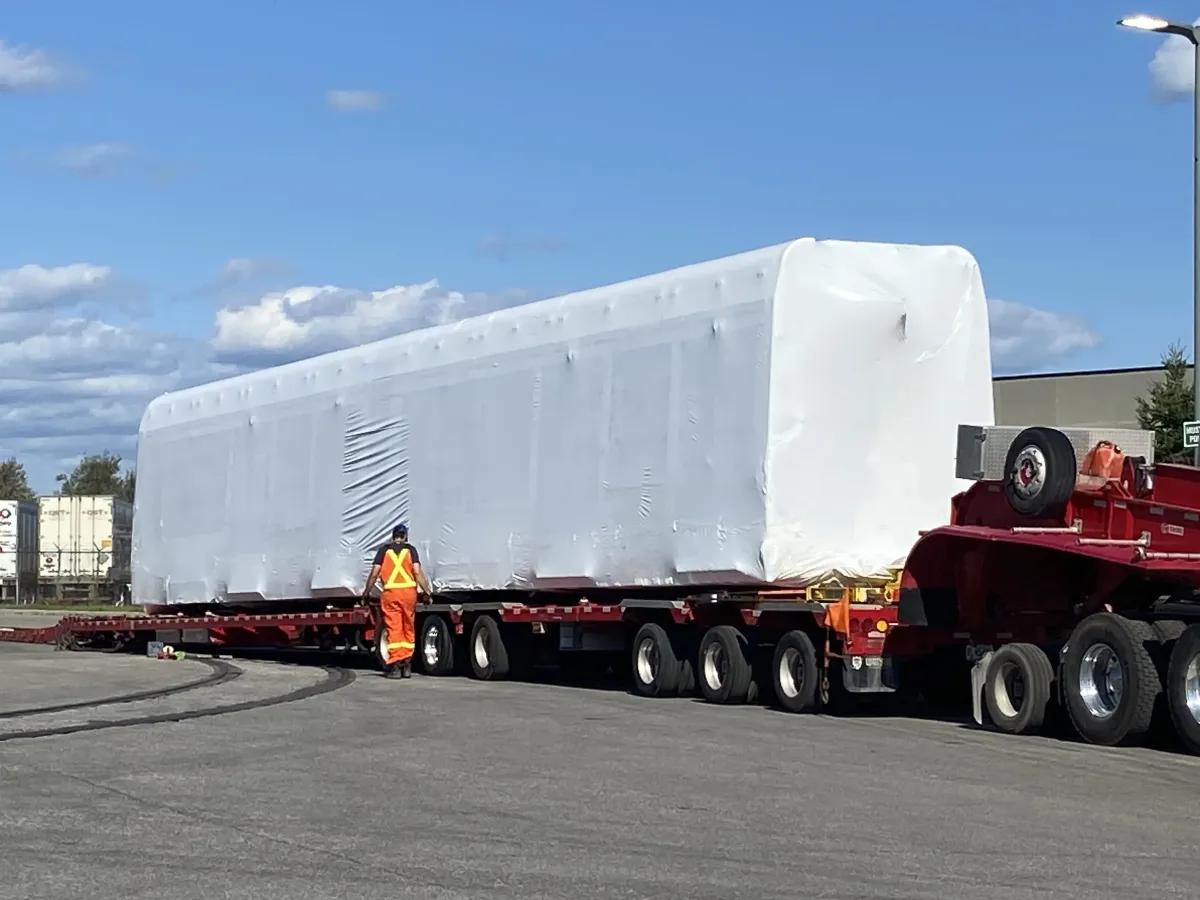
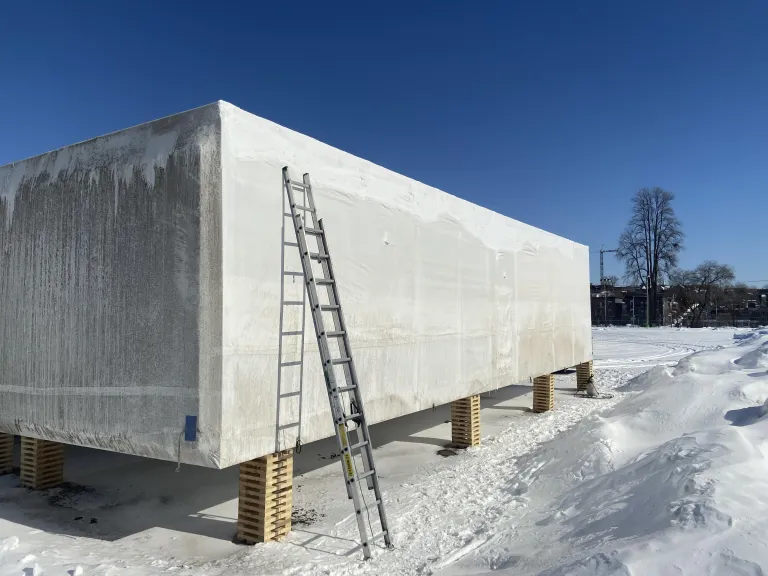
- Duration and purpose. Transit protection for one highway run is specified differently than a wrap meant to stand through an Ontario winter in outdoor storage.
- Travel. Mobile service prices the drive past a home radius. Bigger jobs absorb it; small remote ones feel it.
Site paperwork rides on top: WSIB clearance, insurance certificates, and where a torch is involved, your site's hot work permit process — we've written a full guide to hot work permits for shrink wrapping. None of it should surprise a competent contractor, and all of it belongs in the quote, not the invoice.
Want a real number instead of a range? A photo, rough dimensions and a postal code are enough for a same-day ballpark on most jobs.
What a complete quote should include
Whoever you call, make the quote spell these out. If any of them turn up later as extras, the low bid wasn't low.
- Film specificationMil thickness, colour, and whether flame-retardant grade is needed for your site. The film decides how the wrap survives — and what it's safe near.
- Support framingWhat structure gets built, from what, and whether it's in the price. "Film only" quotes grow on contact with reality.
- Ventilation and desiccantVents are what stand between a sealed wrap and a condensation problem. A number, not a "yes".
- Removal and disposalUsually priced separately — published Canadian removal rates run about $5 a foot in BC and from $75 a job in Ontario. Ask now, not in spring.
- Travel and taxesWhether the drive is included, and HST shown — the City of Barrie prints its 13% line; your contractor can too.
- Paperwork on requestWSIB clearance certificate and proof of insurance before the crew is scheduled. Standard for any competent operator.
That's the standard we quote to. If a quote you're holding doesn't answer all six, send it over with your dimensions and we'll price the same job properly.
Train your own crew to wrap
If permits are a recurring conversation at your site, it's usually cheaper to have your own people trained to handle the routine work.
- One day on site, 3–6 people, your own dock or yard
- All five attachment methods, propane tool handling, ventilation and on-site safety
- Starter kit supplied, plus equipment recommendations beforehand
- Free phone support for the first month of real jobs
Frequently asked questions
How much does shrink wrap cost?
Published Canadian rates for boats and RVs run about $17–31 per foot depending on size, access and what's included. Industrial and equipment wrapping is quoted per job in Canada, built from height, access, framing, film grade and travel — the only published Canadian industrial anchor is $1.55 per square foot for scaffold containment in BC.
How much does it cost to shrink wrap a 20 ft boat?
The City of Barrie's marina prices a 20-footer at $20 a foot — $400 plus HST — as a drop-off service. A Niagara mobile operator quotes the average runabout at $180–300. Mobile service at your driveway or dock varies with access and framing, which is why per-foot cards carry ranges.
What is the price of a 24-inch shrink wrap roll?
Retail centerfold rolls in that width run roughly $100–250 in Canada. Wide marine and industrial rolls — 14 to 40 feet — run $300 to over $1,800 depending on width and mil. But a roll price isn't a job price: on a mid-size machine the film itself is usually under $100 of the total.
How much does a shrink wrapping machine cost?
Basic heat-gun-and-film systems retail around $500–550 in Canada; automated shrink tunnels for packaging lines run to six figures. For wrapping equipment, freight or boats occasionally, hiring a mobile crew costs less than owning the tools and learning on your own asset.
Is shrink wrapping cheaper than crating?
As packaging, usually yes — published US benchmarks put custom crates at $1,000–5,000+ while wrapping runs a fraction of that, and for dense machines the freight cost is nearly identical either way. Crating earns its price when the load needs impact protection. We've written a full comparison of shrink wrap versus crating for shipping.
Does the quote include spring removal?
Usually not — removal is priced separately across the Canadian market, typically around $5 per foot in published BC rates and from $75 a job in Ontario. Ask when you book the wrap, and ask where the film goes: recycling programs for used shrink wrap in Eastern Ontario are currently very limited.
Why don't industrial shrink wrappers publish prices?
Because two jobs with the same footprint can differ by multiples: height, access, framing, film grade, wind exposure and travel all move the number. The honest substitute for a rate card is a fast quote — a photo, dimensions and a postal code usually get a same-day ballpark.
Sources used in this article
- City of Barrie — Fees By-law, Schedule L (marina shrink wrap rates)
- Dyck's Mobile Shrink Wrap — published pricing, Kelowna BC
- M.A.D Mobile Shrink Wrap — boat pricing and removal pages, Niagara ON
- Fish Bay Marina, Fenelon Falls Marina, Marine Plaza — published Ontario marina rates
- Hex Scaffolding Inc. — published containment rate, Kelowna BC
- Canadian retail film pricing — Uline, Global Industrial, Grainger, Amazon.ca listings, August 2026
On-site wrapping across Ontario
Industrial machinery & equipment
On-site protection for machinery, tooling and high-value equipment.
See details →Freight & cargo protection
Flatbed loads and oversized freight wrapped before transit.
See details →Construction containment
Sealed enclosures for containment, weather protection and temporary work areas.
See details →Outdoor storage protection
Equipment and assets sealed for laydown yards and seasonal storage.
See details →Vehicles & marine
Boats, vehicles and seasonal assets wrapped for storage or transport.
See details →On-site shrink wrap training
One day, 3–6 people, your own dock. Starter kit included.
See details →Protect All Shrink Wrapping Services — mobile, on-site industrial shrink wrapping across Ontario, based in Kingston, 17+ years in the trade.
Want a number for your job?
Send a photo, rough dimensions and where it sits. We'll come back with a real quote — film spec, framing, venting, travel and HST spelled out — and the WSIB and insurance paperwork alongside it.

© Copyright 2026. Kingston, Canada. All rights reserved.